
Monument signs / Guide 01
How Much Does a Custom Monument Sign Cost?
Custom monument signs rarely cost less than $10,000. Most projects are five-figure investments, and larger or more elaborate monuments can readily reach $100,000 or more. The installed budget depends on design, materials, lighting, engineering, and site work.
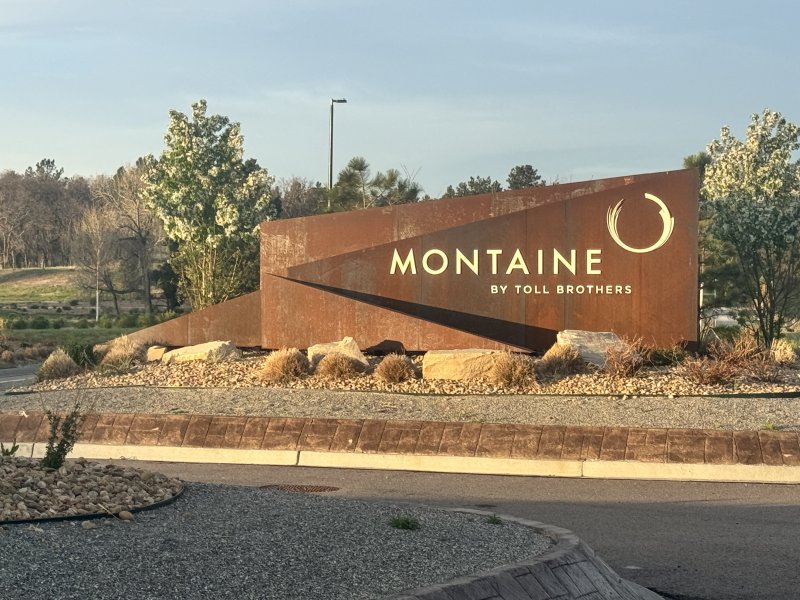
Budget for an architectural project.
Custom monument projects rarely fall below $10,000.
Larger structures and elaborate projects can readily reach this level or higher.
Planning expectations, not a price list. The site and scope determine the estimate. Project photos illustrate construction styles; they do not indicate those projects’ prices.
One of the first questions we hear when someone starts considering a monument sign is also the most reasonable: How much is this going to cost?
Unfortunately, there is no useful one-price-fits-all answer. A monument sign is much closer to a small architectural project than it is to ordering a printed banner. Size, structure, materials, illumination, engineering, excavation, electrical work, permitting and the conditions at the installation site can all substantially change the price.
Custom monument signs rarely cost less than $10,000. Most projects are five-figure investments—tens of thousands of dollars—and larger or more elaborate architectural monuments can readily reach six figures ($100,000 or more). Masonry, dimensional lettering, internal illumination, engineering and substantial site work all affect the installed budget. Large developments and multi-tenant properties can require considerably more. These are budgeting expectations, not a fixed price or a ceiling.
The better question is: What goes into the cost of a monument sign, and where should you spend your money?
The Sign Structure Is Usually the Starting Point
A monument sign is a freestanding sign mounted relatively close to the ground. Unlike a temporary sign or simple post-and-panel sign, it typically contains an internal supporting structure attached to a concrete foundation.
That structure has to deal with wind, snow, weather and its own weight for many years.
A smaller monument might use an aluminum or steel framework with fabricated exterior panels. A larger sign may require substantial steel framing, reinforced concrete footings or engineered structural components.
As the sign becomes taller or wider, the structural requirements usually increase as well. Location also matters. A sign exposed to strong winds on an open site may require different engineering than the same sign installed in a protected location.
This is one reason comparing monument-sign prices based only on square footage rarely works.
What makes up the installed cost?

Each part contributes to the estimate. This diagram shows cost categories, not percentage allocations.
Materials Make a Big Difference
The exterior of a monument sign can be constructed from many different materials.
Common choices include:
- Fabricated aluminum
- Architectural metal panels
- Masonry
- Stone or stone veneer
- Brick
- Stucco
- High-density urethane, or HDU
- Acrylic
- Aluminum composite materials
- Dimensional metal letters and logos
Often the best monuments use several materials together.
For example, a sign might have a fabricated aluminum cabinet supported by a masonry-looking base with routed HDU accents and dimensional aluminum lettering.
The goal is not necessarily to use the most expensive material. The goal is to choose materials that create the architectural appearance you want without creating unnecessary maintenance.
HDU is particularly useful when dimensional shapes, carved details or architectural textures are desired. Manufacturers of HDU sign substrates specifically identify monument signs and dimensional signage as common applications, and polyurethane HDU is valued because it can be machined and shaped while resisting moisture and atmospheric exposure.

Architectural presence comes from multiple trades.
Masonry, fabricated metal, dimensional lettering, and site work all contribute to the installed budget.
Illumination Changes Both the Sign and the Budget
Lighting can add significant value to a monument sign, particularly for businesses, medical facilities, apartment communities and developments that need to be identified after dark.
But illumination adds several components.
An internally illuminated monument may require LED modules, power supplies, wiring, electrical access, translucent graphics and provisions for future service.
External illumination may instead use ground-mounted or architectural fixtures.
Electric signs also have safety and construction requirements that do not apply to non-electric signs. UL 48 is the principal safety standard covering electric signs, and the National Electrical Code includes requirements for electric signs and outline lighting.
Electrical work also has to reach the sign.
If power already exists near the proposed location, that may be fairly simple. If a contractor has to trench 100 feet across a landscaped property or parking lot, the electrical portion of the project can become considerably more expensive.
Excavation and Installation Are Often Underestimated
The beautiful part of the sign is what everyone sees.
The expensive part may be underground.
A monument sign normally needs concrete footings or another engineered foundation. That means excavation, concrete, reinforcing material and installation labor.
Site conditions can change that dramatically.
Is the installation in soil or through an existing concrete pad? Are there irrigation lines nearby? Is the site accessible with installation equipment? Are underground utilities present? Is the sign on a slope? Does traffic control need to be provided?
Two identical monuments can have very different installed prices simply because one site is easy to work on and the other is not.
Same sign. Different site. Different budget.

Site conditions can change the installed price even when the sign design stays the same.
Permitting and Engineering May Be Required
Most communities regulate permanent signs, including monument signs. Regulations may control the sign’s height, area, setback, illumination, location and sometimes architectural appearance.
The International Sign Association notes that most communities require permits for new signs and that approval may involve both objective sign-code review and, in some jurisdictions, separate design review.
Some projects also require engineered drawings.
Engineering is especially likely when a freestanding sign is larger, taller, unusually shaped or located in an area with significant structural requirements.
Those costs should be considered before a final sign price is established—not added as an unpleasant surprise after a design has already been approved.
Your Logo Can Affect the Cost More Than You Might Think
Simple typography is relatively easy to fabricate.
Complex logos are not.
A logo with several colors, intricate shapes, thin lines, layered dimensional elements or specialty finishes can require significantly more fabrication time.
That doesn’t mean the logo needs to be simplified beyond recognition. It means the design needs to translate intelligently from a computer screen into physical materials.
A good monument-sign design preserves the identity of the brand while adapting it to something that can be fabricated, installed and read from the street.

Part of the investment is below ground.
Foundation work, utility coordination, and getting power to the sign belong in the estimate.
Electronic Message Centers Are a Separate Cost Category
Adding a digital message display can increase a monument sign’s cost significantly.
The display itself is a sophisticated electronic product. The structure also has to be designed around it, power requirements increase, ventilation and access may need to be considered, and local sign codes frequently regulate electronic displays differently from static signs.
If an electronic message center is part of the project, it should be included in the design process from the beginning rather than treated as something that will simply be inserted later.
Think beyond the purchase price.

A durable, serviceable design considers the costs that follow installation.
Don’t Judge a Monument Sign Only by Its Initial Price
The cheapest sign is not necessarily the least expensive sign.
A monument that needs constant repainting, has difficult-to-service lighting, uses inappropriate exterior materials or begins deteriorating prematurely can become costly very quickly.
A well-designed monument sign should be thought of in terms of its useful life.
If a quality monument remains attractive and functional for many years, the difference between two initial proposals may become fairly small when spread over the life of the sign.
That doesn’t mean every project needs premium materials everywhere. In fact, smart value engineering is one of the most important parts of sign design.
Spend money where it matters.
Use durable structural materials. Make the identifying copy readable. Use quality finishes where they are exposed to the weather. Design service access into illuminated signs.
And don’t spend $5,000 creating a decorative detail that nobody traveling past the property at 35 miles per hour will ever notice.
What Do We Need to Price a Monument Sign?
You do not necessarily need completed architectural drawings.
A useful starting package typically includes:
- The property address.
- Photos of the proposed location.
- Approximate desired dimensions.
- Your logo or branding.
- Examples of signs or architectural styles you like.
- Information about illumination.
- Any landlord, developer, HOA or municipal sign criteria you already have.
From there, the design can begin to take shape.
A monument sign is not simply a board with a logo on it. It is part architecture, part advertising and part fabrication. The best projects balance all three.
If you’re budgeting for a monument sign, start with the site and the objective rather than trying to select a sign from a price chart. Once those pieces are understood, a realistic budget becomes much easier to establish.
Sources & further reading
UL Solutions: electric signs, UL 48, and NEC Article 600 ↗ City and County of Denver: sign and electrical permit requirements ↗ Precision Board: HDU performance in exterior signs ↗Permit requirements are property-specific. Confirm the locally adopted code and edition. Denver is a local example, not a statewide rule.
