
Monument signs / Guide 07
Can Monument Signs Be Internally Illuminated or Externally Illuminated?
Monument signs can use internal lighting, push-through acrylic, halo-lit or face-lit letters, external fixtures, or a combination. Match the lighting to the architecture, visibility needs, available power, and local rules.
Yes—and choosing between internal and external illumination can completely change the character of a monument sign.
There is no universal “best” method.
The right lighting depends on the sign design, the architecture of the property, viewing distance, local regulations, existing electrical service and the visual effect you want after dark.
Some monuments should glow.
Others should be dramatically lit.
And some look better with only the identifying letters illuminated while the structure itself disappears into the evening.
Let’s look at the major options.
What Is an Internally Illuminated Monument Sign?
Internal illumination means the light source is located inside the sign.
The most familiar example is a sign cabinet with a translucent face.
LED modules inside the cabinet illuminate the face, letters or logo.
Modern monument signs can use internal illumination much more selectively.
Instead of illuminating an entire rectangular panel, we can route the sign face and insert acrylic letters or logos.
Those elements illuminate while the surrounding aluminum face remains opaque.
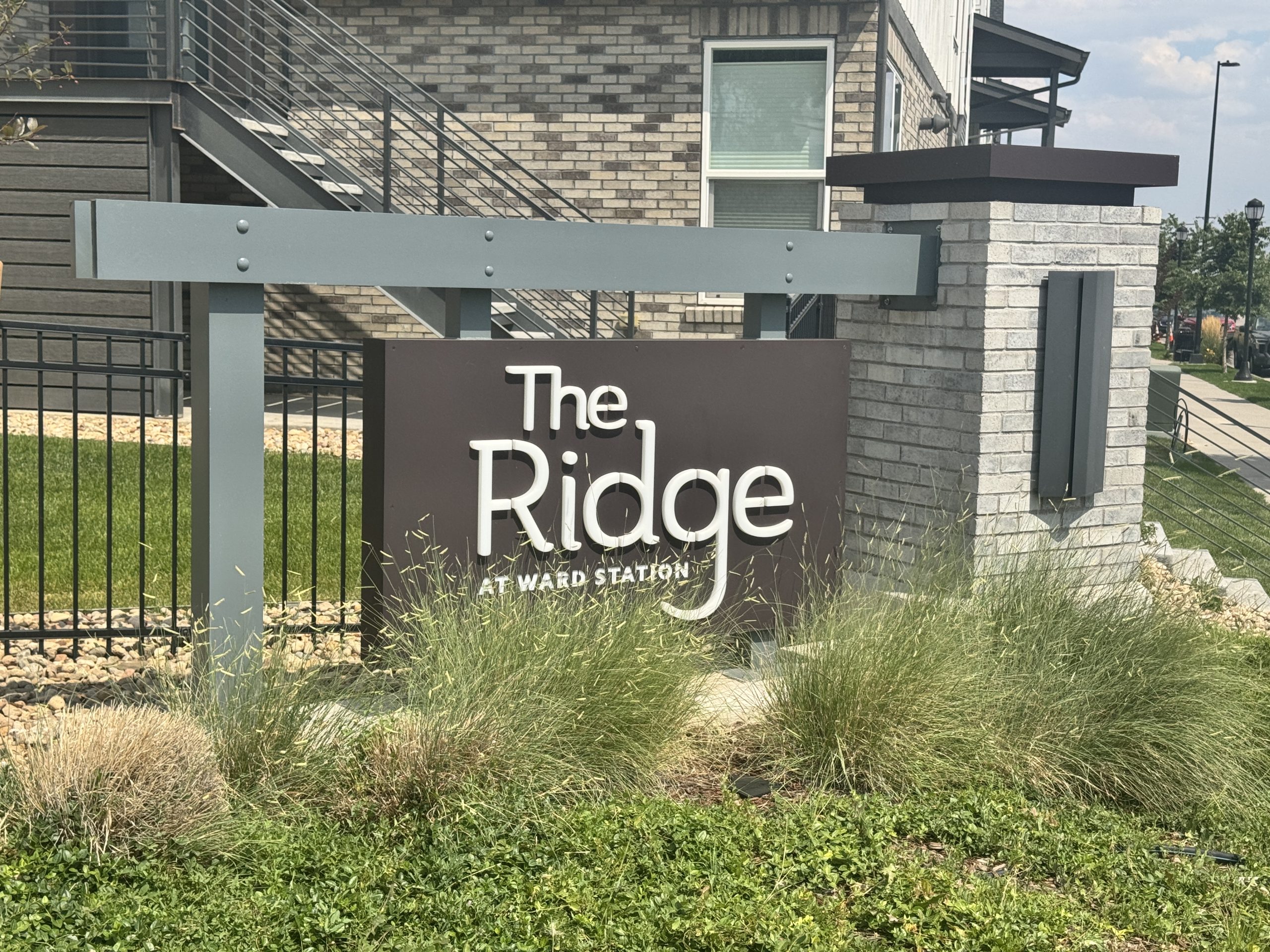
Architectural Signs used that approach at The Ridge at Ward Station, where fabricated aluminum cabinets were combined with push-through acrylic lettering and internal LED illumination.
During daylight, the letters remain dimensional architectural elements.
At night, the illuminated acrylic creates a distinct identity without turning the entire monument into a glowing box.
Where the light comes from changes the effect.

Choose the lighting method with the sign design, materials, and viewing conditions.
Push-Through Acrylic
Push-through lettering is one of our favorite techniques for architectural monument signs.
The basic idea is straightforward.
Letters or logos are routed from the opaque metal face of the monument.
Thick acrylic shapes extend through those openings.
LED lighting inside the cabinet illuminates the acrylic.
Depending on the construction, illumination can come through:
- The face
- The edges
- The sides
- A combination of surfaces
The result has much more dimension than a flat translucent panel.
It works particularly well for multifamily communities, office developments, hotels, medical campuses and higher-end commercial properties.
Halo-Lit Monument Letters
Halo illumination creates a softer effect.
Rather than shining toward the viewer, LED lighting is positioned behind dimensional letters.
The light hits the background surface and forms a glow around the letters.
Architectural Signs has used halo lighting on Colorado monument projects, including the Pradera community entrance.
Halo lighting can feel more architectural than a traditional internally illuminated cabinet.
It is particularly effective against stone, metal or opaque painted surfaces.
The wall surface matters, though.
A smooth light-colored surface reflects light differently than highly textured dark stone.
That needs to be considered during design.

Illuminate the identity selectively.
Illuminated acrylic can give the name dimension while the surrounding metal remains opaque.
Face-Lit Letters
Face illumination is another option.
Letters can have opaque returns with translucent acrylic faces.
LEDs inside the letters illuminate forward through the face.
This approach is common on building signs but can also be incorporated into monument structures.
Face-lit letters generally create stronger direct visibility than halo lighting.
If the property is along a busy roadway where nighttime identification is the primary goal, stronger face illumination may make sense.
What Is External Illumination?
External illumination means the monument itself contains little or no lighting.
Instead, separate fixtures illuminate the sign.
These might include:
- Ground-mounted uplights
- Landscape lighting
- Architectural floodlights
- Fixtures concealed in landscaping
- Downlighting integrated into a cap or architectural feature
External illumination works beautifully with stone monuments, carved signs and dimensional metal lettering.
It creates highlights and shadows that can actually make dimensional components more dramatic than internal illumination.
The Advantages of External Lighting
External illumination can simplify the sign construction.
The monument does not necessarily need an electrical cabinet, translucent materials or internal service access.
That can be particularly useful with real stone or masonry monuments.
External light also reveals surface texture.
If you spent money on dimensional limestone lettering or a beautiful stacked-stone wall, washing that surface with light can make the architecture part of the nighttime presentation.
Internal illumination might hide some of that detail.
Good external lighting needs room to work.

Coordinate fixtures with landscaping and maintenance as well as the sign itself.
The Disadvantages of External Lighting
Fixture placement matters enormously.
Poorly positioned floodlights can create glare.
Landscaping can grow in front of them.
Snow can cover low fixtures.
Mowers and maintenance crews can damage them.
Someone may also unknowingly adjust the fixture and leave the sign dramatically illuminating a cottonwood tree instead of the company logo.
External lighting needs to be treated as part of the overall sign and landscape plan.
Can We Combine Lighting Methods?
Absolutely.
Some of the strongest monument-sign designs use multiple layers.
For example:
- Halo-lit letters on the primary sign panel
- Subtle landscape lighting on the masonry
- Downlighting on an address panel
- Internally illuminated directional information
The goal is not to create Las Vegas in the parking lot.
The goal is visual hierarchy.
The property name should generally receive the strongest emphasis.
Secondary elements should remain secondary.

Let external light reveal the architecture.
Controlled fixture placement can reveal stone texture and dimensional lettering.
Electrical Safety Matters
Once electricity is incorporated into the sign, the construction falls into another category of safety requirements.
UL 48 covers electric signs, including signs illuminated with LED technology. The National Electrical Code addresses electric-sign installation through Article 600.
Depending on the jurisdiction and project, electrical permitting, inspection or work by licensed electrical trades may be required.
We address those requirements during project planning rather than treating the power connection as an afterthought.
Where Is the Power Coming From?
This question can affect the budget more than the lighting style itself.
If electrical power already exists at an existing monument, an illuminated renovation may be relatively straightforward.
On a new site, power may need to be trenched from a building or another electrical source.
That can involve:
- Trenching
- Conduit
- Electrical wiring
- Concrete or asphalt cutting
- Landscape restoration
- Additional permits
If illumination is important, identify the electrical conditions early.
Plan the power before choosing the final lighting.

Electrical requirements, permits, and qualified trades depend on the project and jurisdiction.
Local Lighting Rules Matter
Municipal codes and private development standards may regulate sign illumination.
Requirements may address:
- Brightness
- Hours of operation
- Flashing or animation
- Electronic displays
- Light spill
- Nearby residential properties
A lighting concept should therefore be evaluated as part of the permit process.
Which Lighting Style Should You Choose?
Ask what you want the monument to accomplish at night.
If maximum identification is the priority, internal face illumination or illuminated acrylic may make sense.
If architectural elegance is more important, halo illumination or external lighting may be preferable.
If the monument is primarily stone, external lighting can be very effective.
If it is a contemporary fabricated aluminum sign, internal LED lighting may integrate beautifully.
The best illuminated monument sign should not look like someone added lights to a sign. It should look like the lighting was part of the architecture from the beginning.
Sources & further reading
Architectural Signs: The Ridge at Ward Station ↗ UL Solutions: electric signs, UL 48, and NEC Article 600 ↗ City and County of Denver: sign and electrical permit requirements ↗Permit requirements are property-specific. Confirm the locally adopted code and edition. Denver is a local example, not a statewide rule.
